
The challenge
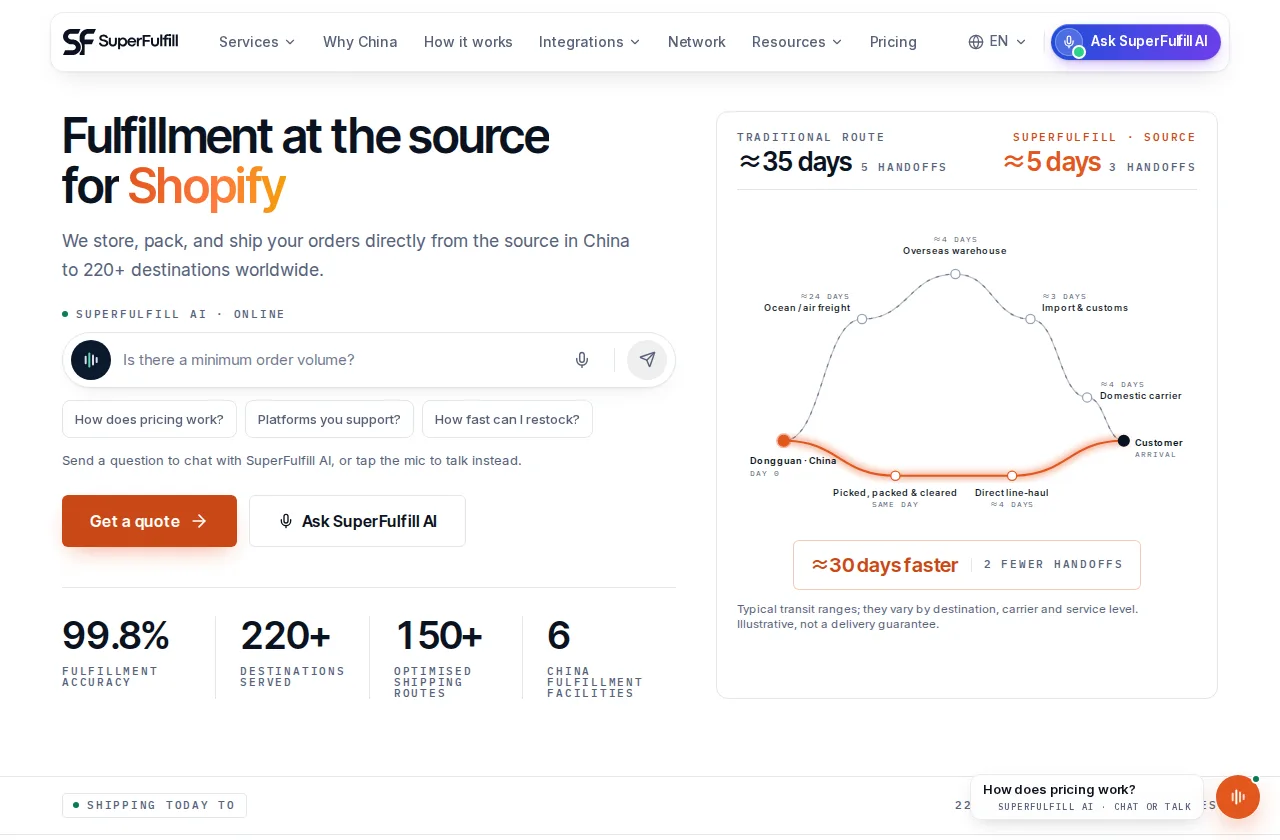
SuperFulfill stores, picks, packs and ships from its own facilities in Dongguan, Guangzhou and Hangzhou to more than 220 destinations, for brands selling on Shopify, Amazon, TikTok Shop, WooCommerce, eBay and B2B. The warehouse runs on MaBang (马帮) — the Chinese system of record for orders, stock, carriers and tracking. It is operator-facing, Chinese-language, and closed to clients by design.
So a brand in Sydney messages “order 3021 is going to the wrong address,” and that sentence has to cross three boundaries before a single carton moves: English to Chinese, chat message to order record, and request to physical warehouse action. At every boundary, a person is holding the state in their head.
Requests handled that way don’t fail loudly. Nobody says no. The message simply never becomes an action — and by the time the client asks a second time, the parcel has already shipped. A chat thread has no owner, no due date and no memory; that is the whole problem in one line.
Why this is a logistics problem, not a chat problem
Cross-border fulfillment out of China puts the person who asks and the person who acts on opposite sides of a language, a time zone and a system boundary. The client works in English, in Shopify or TikTok Shop, during their own business hours. The warehouse works in Chinese, in MaBang, during theirs. Nothing connects the two except a chat window and an operator’s memory.
That gap is not unique to one 3PL — it is the standard shape of the industry. Every Chinese fulfillment partner runs an operator-facing WMS its clients cannot see, and every overseas brand reaches it through a messaging app. The result is a fulfillment operation whose customer-facing layer has no record, no ownership and no clock, sitting on top of a warehouse layer that has all three.
The loss is invisible by construction. A dropped address change looks exactly like a handled one until the tracking number moves. There is no queue to inspect, no age to measure and no owner to ask — so the failures are only ever counted in refunds, chargebacks and churn, long after the week in which they happened.
The CallSphere solution
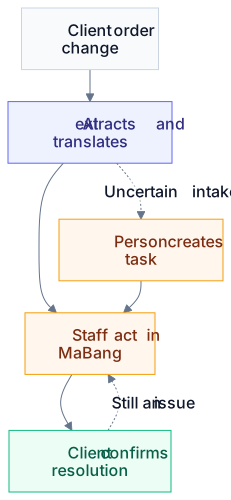
CallSphere built SuperFulfill a communication operating system where every inbound message — text, voice note or attachment — becomes a structured task before anyone touches the warehouse. AI intake separates conversation from action, extracts the order numbers and the requested change, and asks for whatever identifier is missing instead of guessing. One request can legitimately carry several order numbers, and it stays one request. When intake is uncertain or the AI provider is unreachable, the original message is kept and a person creates the task by hand — the request is never dropped because a model was unavailable.
The original message is immutable, enforced in the database rather than by convention: triggers prohibit editing or deleting an original, and audit rows cannot be rewritten. The English and Chinese versions are separate records alongside it, never overwrites of it, so the evidence of what the client actually said survives translation — which is what makes a disputed instruction resolvable weeks later.
Closing a task requires a staff assertion that the manual MaBang action was actually performed, plus a resolution note saying what was done. The platform deliberately does not execute or verify warehouse operations, and the AI cannot move a task’s status: it reads and drafts, people act, and the record keeps the two apart. The client then confirms, or presses “Still an issue,” which reopens the same task ID with its history intact and its reopen counter incremented, rather than starting a fresh thread that has forgotten everything.
Admin, staff and client all sign in at the same door and land in the same application. Stored permissions decide the navigation, the actions and the records — there is no role selector and no separate portals drifting out of sync. Internal notes, root-cause analysis and private files live in separate tables that the client projection simply cannot reach.
The public front door
CallSphere also built and runs superfulfill.com — the multi-page marketing site, its permanent SEO URL structure, machine-readable llms.txt for AI answer engines, and SuperFulfill AI, a representative visitors can talk to by voice or type to in one popup, in their own language.
Every fact the site and the agent state comes from one source-of-truth content module, so the sales pitch, the FAQ and the AI’s answers cannot drift apart. The same discipline that keeps a task honest keeps the marketing honest.
The MaBang loop
Order, carrier, tracking and ship-time data land against every task, so staff stop hunting between two systems to answer a question about one parcel. Today that data arrives by import; live synchronization with MaBang is on the roadmap, and the platform is deliberately explicit about the difference rather than implying an integration it does not yet have.
The effect is that a task is not just a message with a status on it — it is a message joined to the shipment it is about.
The results
Once every request is a typed, timed, owned record, operations stop being a matter of recollection. SuperFulfill can see open, overdue, unassigned, reopened, resolved and pending-confirmation counts; average time to first action and to resolution; issue types, client request volume, staff workload and root causes. On the order side: fulfillment-speed buckets, store value against reported profit, market mix by destination, SKU demand, carrier allocation, per-currency summaries and the full order ledger.
The most useful number on the board is repeated manual actions. If the same manual MaBang fix is performed forty times in a month, that is not a support problem — it is a missing feature or a broken SOP upstream, and the metric names it precisely enough to go and fix it. It turns a support queue into a list of automation targets ranked by the labour they are currently costing.
A single sample export already showed the shape of it: 28 orders across 3 stores, 13 SKUs and 48 units, all shipped, none yet showing tracking online, and two orders losing money. That last pair is exactly the kind of bottleneck an operator working from chat threads could not see before.
CallSphere didn’t make the warehouse faster. It made it impossible to lose a request on the way to the warehouse.