
The challenge
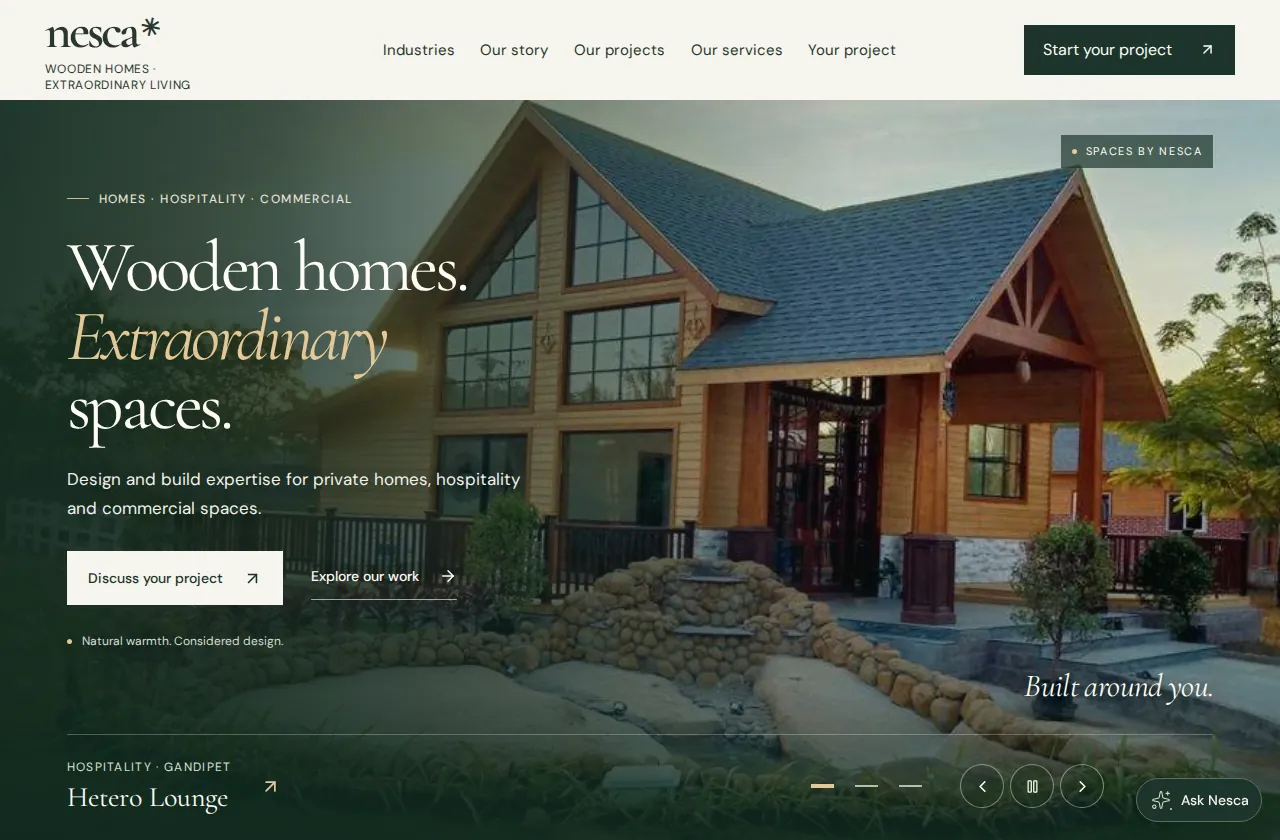
NESCA designs, manufactures, builds and exports timber structures from Hyderabad. NESCA Designs provides structural design and estimation for timber builders in North America, Europe and Australia; NESCA Homes is India’s first premium wooden home builder, with residences, guest houses, lounges and clubhouses across Hyderabad, Gandipet, Adibatla and Kashmir; NESCA Global supplies trusses, frames and kits across borders, starting with Australia. Behind it are more than 20 years of design experience, 75,000+ structures designed and a team of about 250 engineers, designers and craftspeople.
That breadth meant very different conversations arriving through the same doors. A family asking about a wooden farmhouse near Hyderabad, an Australian builder asking about truss supply and a developer sending plans for review all needed a prompt answer, a qualified next step and the right person — and once work began, briefs, design revisions, approvals, milestones, files and payments had to stay connected from first enquiry to handover. With a goal of 1,000 timber structures by 2030, that could not keep living in inboxes, spreadsheets and people’s memory.
The CallSphere solution
CallSphere built NESCA one connected platform. The public website presents the projects, materials, process and gallery, and every enquiry — from the form, the text chatbot or a voice conversation — is saved to the sales pipeline with its source, campaign and referrer, along with the saved transcript.
Behind it, a single admin workspace runs the business: a sales pipeline with one-step conversion of an enquiry into a project; project pages with milestones, blockers, versioned documents and site photos; a design studio with country-specific briefs, revision requests and recorded client approvals; auditable AI price estimates built from area, specification, foundation, transport and site works; contract-bound payment requests with verified receipts; and business insights covering conversion by source and region, design throughput, overdue milestones and demand. Eight roles — administrator, sales, designer, project manager, finance, analyst, homeowner and developer or architect — each see only what their work requires, enforced on the server for every request and file download.
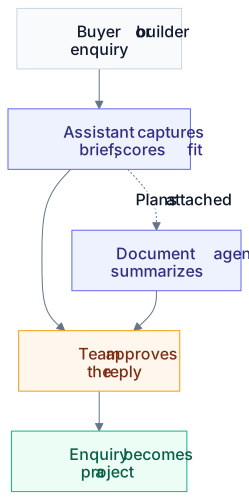
On top sits a customized multi-agent layer. The NESCA Assistant accepts text and voice and coordinates four specialists: an Email Agent that drafts context-aware replies, a Document Processing Agent that extracts customer and project details from PDFs, Office files, images, audio and video, a 3D Model Designing Agent that produces conceptual building designs with saved revisions and GLB/OBJ exports, and a Lead Qualifying Agent that scores fit and prepares prospect imports. Specialists hand work to one another inside the same conversation — a document review can continue into an email draft without another upload — and every completed result is saved to a shared library.
AI that prepares, people who decide
The agents draft; NESCA’s team acts. No email leaves until the recipient and the full message have been read back and confirmed, extracted leads are previewed before anything is added to Prospects, and 3D concepts are labelled as discussion material rather than construction-ready engineering. Payment requests cannot exceed the agreed contract, and only a signed provider notification or a verified receipt marks an invoice paid.
Every agent’s instructions live in a versioned Prompt Library with change notes, author and one-step restore, administrators keep private preferences in Agent Memory, and an Agent Costs view records spend by chat and by agent. When an integration is missing, the workspace shows it as unavailable instead of inventing activity or revenue.
The results
NESCA now has one system that a home buyer in India and a builder in Australia both enter through, and that its sales, design, project and finance teams all work from. Enquiries that arrive at night or over a weekend are answered and captured instead of going cold, documents and plans are summarized before a designer opens them, and leadership sees pipeline, collected revenue, design throughput and AI activity in one place.
Just as important, the workspace is the foundation for the many agents NESCA plans to add. Its records, knowledge base, roles, approvals and audit trail are what every future agent works from, so each new use case plugs into one platform instead of being built in isolation.
NESCA and CallSphere: questions and answers
- What is NESCA?
- NESCA is a Hyderabad-based timber group that designs, manufactures, builds and exports wooden structures. NESCA Homes is India’s first premium wooden home builder, NESCA Designs provides structural design and estimation for timber builders in North America, Europe and Australia, and NESCA Global supplies trusses, frames and kits across borders, starting with Australia.
- What did CallSphere build for NESCA?
- CallSphere built NESCA one connected platform: a public website with a text and voice chatbot that saves every enquiry to the sales pipeline, an admin workspace that runs sales, projects, design approvals, AI price estimates, payments and business insights, and a multi-agent AI layer on top.
- Which AI agents does NESCA use?
- The NESCA Assistant accepts text and voice and coordinates four specialists: an Email Agent that drafts replies, a Document Processing Agent that extracts details from PDFs, Office files, images, audio and video, a 3D Model Designing Agent that produces conceptual building designs, and a Lead Qualifying Agent that scores fit and prepares prospect imports.
- Do NESCA’s AI agents send emails or change records on their own?
- No. The agents draft and NESCA’s team acts. No email leaves until the recipient and full message are confirmed, extracted leads are previewed before they are added to Prospects, 3D concepts are labelled as discussion material rather than construction-ready engineering, and only a signed provider notification or verified receipt marks an invoice paid.
- Who works in NESCA’s CallSphere workspace?
- Eight roles share one workspace: administrator, sales, designer, project manager, finance, analyst, homeowner and developer or architect. Each sees only what their work requires, enforced on the server for every request and file download.