

Forty Lunches, No Onion or Garlic: A Delhi Tour Operator Books Niagara Falls in Hindi
By Sagar Shankaran, Founder of CallSphere
A Delhi tour operator books Jain and vegetarian group lunches at a Niagara Falls restaurant by phone in Hindi, while the manager hears every detail in English.
Key takeaways
Ask ten Niagara Falls restaurant hosts what "vegetarian" means and you will get one answer. Ask a tour operator in Delhi and you will get at least three: no meat, no fish and no eggs for most of the group; no onion, no garlic and nothing grown underground for the Jain families; and, for one grandmother, nothing she has not had explained to her twice. Getting those three meanings onto the right plates for forty people who arrive by coach at a fixed time is a phone call, and very often it is a phone call in Hindi.
This post follows that call from both ends: the operator's office in Delhi booking the season's group lunches, and the tour leader on the coach calling from the road when the headcount changes. The people are composites. The situation will be familiar to any restaurant near the falls that has watched a tour coach pull into its lot.
Why the Delhi office rings in the middle of your lunch rush
Because their evening is your late morning. Delhi runs nine and a half hours ahead of western New York in the summer and ten and a half in the winter, so an operator who finishes the day's client meetings and sits down at 9 p.m. to confirm next month's lunches is calling you at 11:30 a.m., just as the first tables fill.
The caller is often the senior partner of a family-run agency selling the East Coast circuit many Indian groups take: New York City, Niagara Falls, Washington. He reads an English menu without trouble, but he negotiates, explains and double-checks in Hindi, and he wants your answers in Hindi too, because he will repeat them to forty clients and cannot afford to be wrong. When your host answers in quick English with a tray in one hand, two things happen. The operator says "okay, okay" to be polite, and the details that matter, like whether the dal is tempered with garlic, never get asked.
Three kinds of vegetarian on one coach
The dietary list is the heart of the call, and it is more precise than a checkbox on a booking form. A typical list from a Delhi operator covers:
Hear it before you finish reading
Talk to a live CallSphere AI voice agent for hospitality in your browser — 60 seconds, no signup.
- Vegetarian, Indian style. No meat, fish or eggs. Eggs are the item American kitchens most often miss, in breads, desserts and some sauces.
- Jain. Vegetarian, and also no onion, garlic, potatoes, carrots or other root vegetables. Some Jain travellers keep further practices of their own, so the safe move is to ask the operator what each guest observes rather than guess.
- Kitchen handling. Separate pans and spoons for the Jain plates, so they are not finished in the same oil as everything else.
- Medical. A diabetic guest, a nut allergy. These matter most at dessert.
None of this is hard for a good kitchen. What is hard is learning it accurately over the phone, across a language gap, from someone who knows exactly what his clients need and needs to hear that you understood it.
The booking call, line by line, in Hindi and English
With a live interpreter on your restaurant's number, the operator speaks Hindi, your manager hears English a few seconds later, and every answer goes back in Hindi. Nobody has to switch languages to be polite. A shortened version of the call:
- The line answers and offers a language. The operator picks Hindi, and the interpreter voice greets him with "नमस्ते" and explains, in Hindi, that the manager is joining and everything will be interpreted both ways.
- He asks, in Hindi, whether you can seat forty-two for lunch on three dates in July, arriving at 12:15 after the boat ride. Your manager hears it in English and checks the book.
- He reads the dietary list. Your manager asks the question that matters: "For the Jain guests, are tomatoes, ginger and green chili all right?" He hears it in Hindi, answers yes, and adds one exception for a particular family. Your manager hears the exception in English and writes it on the booking.
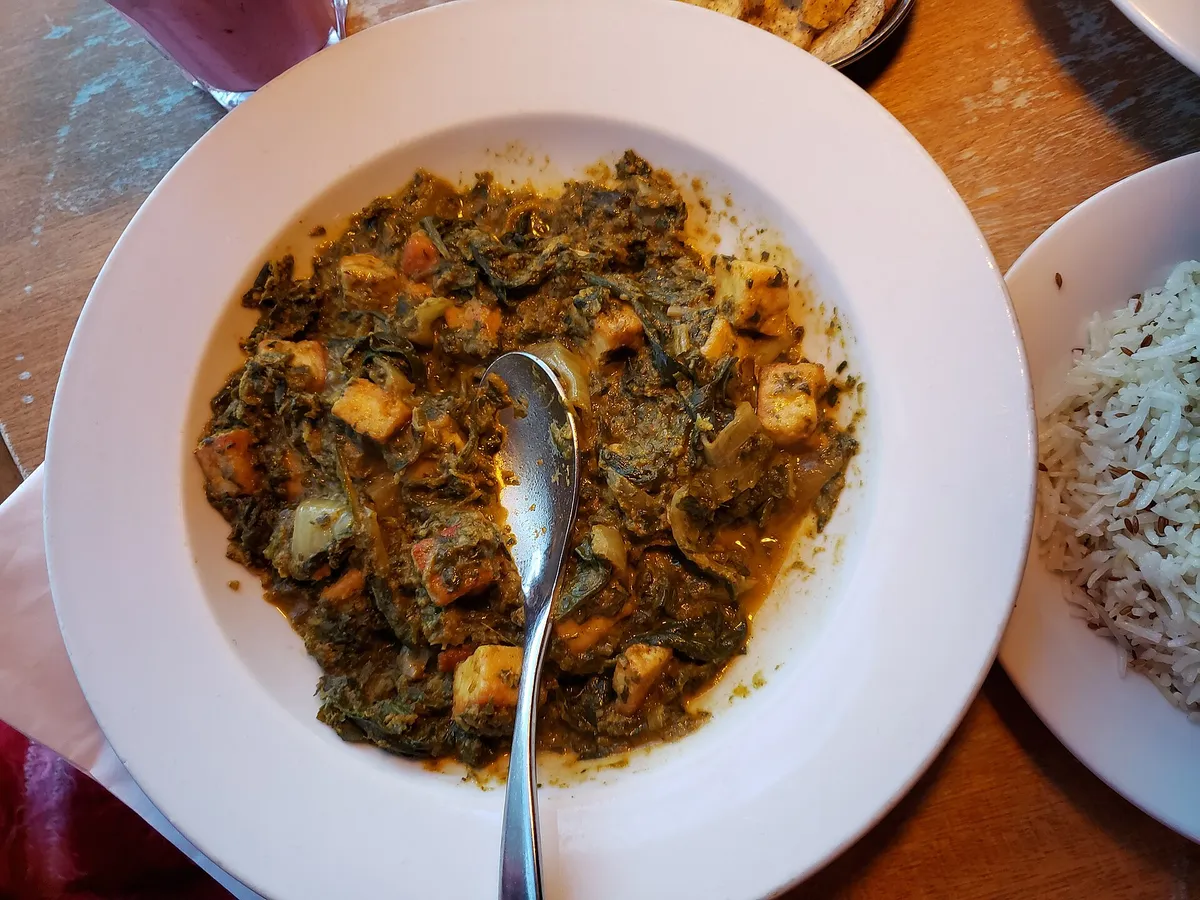
- Your manager proposes a set menu: paneer, two dals, rice, rotis and a vegetable curry, with a separate Jain version of the dal and curry. The operator asks, in Hindi, whether the rotis contain egg. The answer goes back to him in Hindi: no, and the full menu will follow by email.
- They agree the deposit, the cut-off for final numbers and the tour leader's name and mobile. Your manager repeats the dates and counts; the operator hears them in Hindi and confirms each one.
Want to hear it before you trust it? Try the live interpreter in your browser: choose Hindi, have a Hindi-speaking friend play the operator, and take the order in English.
Coach day: the count drops and the boat runs late
On the day itself the call comes from the tour leader, usually from the coach or the state park, and it is short: five guests stayed at the hotel, the boat ran late, the group will be twenty-five minutes behind. A restaurant near the falls might run that call like this, with Hindi and English carried on every step.
flowchart TD
  A[Tour leader calls from the coach, speaking Hindi] --> B[Line offers languages, leader picks Hindi]
  B --> C[Host hears in English: group name, new headcount, new arrival time]
  C --> D{More than 30 minutes late?}
  D -->|Yes| E[Manager offers a later seating or packed lunches, explained in Hindi]
  D -->|No| F[Kitchen holds the set menu, Jain plates kept separate]
  E --> G[Leader chooses an option in Hindi, host hears it in English]
  F --> H[Host repeats the new count, leader confirms in Hindi]
  G --> I[Bill adjusted under the agreed cut-off rules]
  H --> I
  I --> J[Group seated, Jain table marked for the servers]
The decision branch is yours to set. Some kitchens can slide a group seating by half an hour on a weekday and cannot on a Saturday in August. Decide the rule before the season and the interpreter carries it to the tour leader in Hindi, the same way every time.
If nobody can reach the phone because the floor is full, CallSphere's AI receptionist can answer instead, take the new count and arrival time in Hindi, and pass the message to your host stand in English. Same number; the caller never has to know who picked up.
Before next season's coaches arrive
Most of the preparation is about your menu and your rules, not the technology.
Still reading? Stop comparing — try CallSphere live.
See the hospitality AI agent handle a real call — complete, industry-specific, and live in your browser. No signup.
- Write the Jain menu down. One page, in English, listing every dish and every ingredient that touches it. The interpreter carries questions; the answers have to exist first.
- Set a numbers cut-off and say it the same way every time. "Final count by 9 a.m. the day before" is easy to interpret and easy to enforce.
- Agree a late-arrival rule. How late is too late, and what you offer instead.
- Take the tour leader's name and mobile at booking. The day-of call is far easier when you know who is calling.
- Repeat back numbers and dates. Headcount, date, arrival time, deposit. Hearing the confirmation in English closes the loop.
- Think beyond Hindi. The same number gets coach groups from Seoul, São Paulo and Tokyo. The interpreter covers 57+ languages, and its in-call menu includes Hindi, Spanish, Chinese, Arabic, Japanese, Korean and Portuguese.
The restaurant overview shows how the rest of the platform handles reservations and missed calls, and if your group business also fills rooms nearby, the hotel page covers the front desk side. Current plans are on the pricing page.
Frequently asked questions
Our tour operators speak English. Why would they call in Hindi?
Because the hard questions get asked in the language people think in. Many operators speak English and will use it if that is all you offer, but when forty clients' meals depend on garlic in a tempering or egg in a bread, they want to ask in Hindi and hear the answer in Hindi. The restaurant where that was easy is the one they book again.
Can the interpreter tell us what Jain guests can eat?
No. It interprets; it does not advise. Your manager asks and the operator answers. Practices differ between families, so the reliable approach is to ask what each guest observes, write it on the booking and read it back before the date.
What happens when the tour leader calls from a noisy coach?
It still works: the interpreter runs on ordinary phone calls, mobiles included. Background noise makes any call harder, interpreted or not, so keep sentences short and repeat the numbers back. Your host says the new headcount, the leader hears it in Hindi and confirms, and everyone knows the count is right.
Does it work on the number already listed on our website and menus?
Yes. The interpreter joins calls on your existing number, so operators keep calling the line they already have. The caller can choose a language at the start, and from then on each side hears their own language until the call ends.
What if an elder on the coach prefers a language other than Hindi?
Test it before you rely on it. The interpreter covers 57+ languages, and Hindi is on its in-call menu, but if your callers regularly prefer another Indian language, run a few real calls first. Most Delhi operators and tour leaders are comfortable handling a booking in Hindi.
The fastest way to judge it is to run the booking call yourself. Open the live interpreter, pick Hindi, and have a colleague read you a Jain lunch order. Five minutes will tell you whether your kitchen would have got it right.

Written by
Sagar Shankaran· Founder, CallSphere
LinkedInSagar Shankaran is the founder of CallSphere, where he builds production AI voice and chat agents deployed across healthcare, hospitality, real estate, and home services. He writes about agentic AI, LLM engineering, and shipping voice agents that handle real calls in production.
Try CallSphere AI Voice Agents
See how AI voice agents work for your industry. Live demo available -- no signup required.


