

AI-Enabled Data Migration: Generating Verified dbt Models, From Scratch and Incrementally
By Sagar Shankaran, Founder of CallSphere
Data migration is often the longest pole in any data-platform program. The heavy lifting — translating a mapping document into reliable transformation logic — is slow, repetitive, and unforgiving of small errors.
So we set out to answer a focused question: can generative AI take a mapping document and produce complete, reliable dbt models — under strict governance, with a human expert in the loop?
The short answer is yes. Below are two use cases we validated, the four-step flow that keeps the output consistent, and the controls that keep it trustworthy.
At a glance
- AI generates complete dbt models from a mapping document, and adds incremental fields and updates to existing models.
- A fixed flow — Input → Enhance → Validate → Generate — keeps results consistent.
- A human SME validates and tunes every model; nothing ships unreviewed.
- All terminology is masked, work stays inside approved cloud boundaries, and testing is security-first, under official AI policy.
- Output quality tracks directly with mapping-document precision and structured prompting.
What is AI-enabled data migration?
flowchart LR
  A["Mapping document"] --> B["Structured prompt"]
  E["Existing SQL (incremental)"] --> B
  B --> C["Generative AI"]
  C --> D["Draft dbt model / SQL"]
  D --> V{"SME validation & tuning"}
  V -->|"Needs changes"| B
  V -->|"Approved"| S["Verified model shipped"]
AI-enabled data migration is the use of generative AI to produce and update the transformation code — here, dbt (data build tool) models and SQL — that moves and reshapes data from source to target. Existing mapping specifications are the input, and a subject-matter expert stays in the validation loop. The goal isn't to remove engineers; it's to compress the most repetitive part of migration while keeping human judgment where it matters.
One governed flow, applied to every script
Both use cases run through the same four steps:
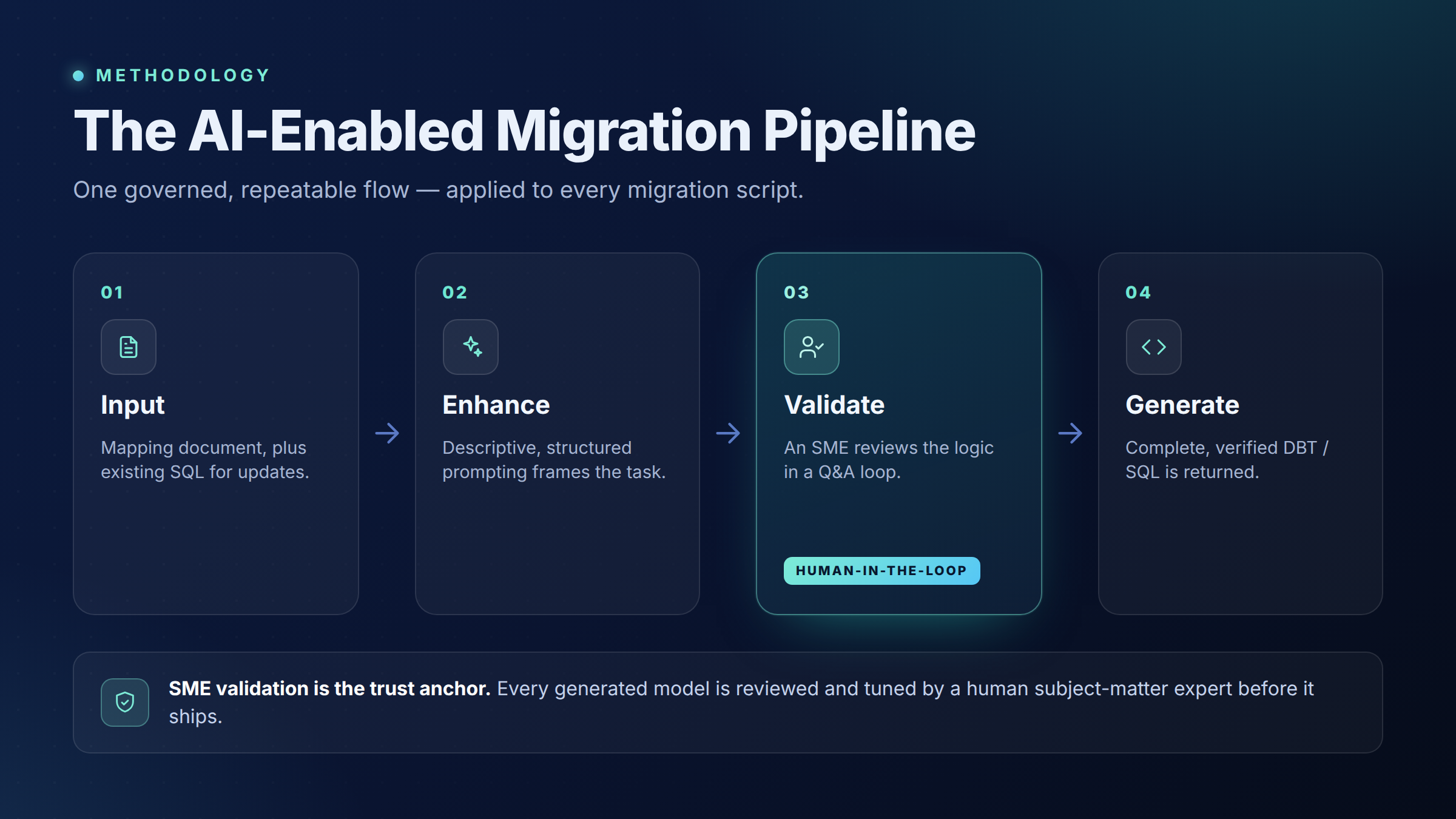
- Input — the mapping document (plus existing SQL, for updates).
- Enhance — descriptive, structured prompting frames the task and the expected logic.
- Validate — an SME reviews the proposed logic in a human Q&A loop.
- Generate — complete, verified dbt / SQL is returned.
The validation step is the trust anchor. Structured prompting and good inputs get you a strong draft; the SME makes it production-ready.
Hear it before you finish reading
Talk to a live CallSphere AI voice agent in your browser — 60 seconds, no signup.
Use case 1 — Initial load script generation
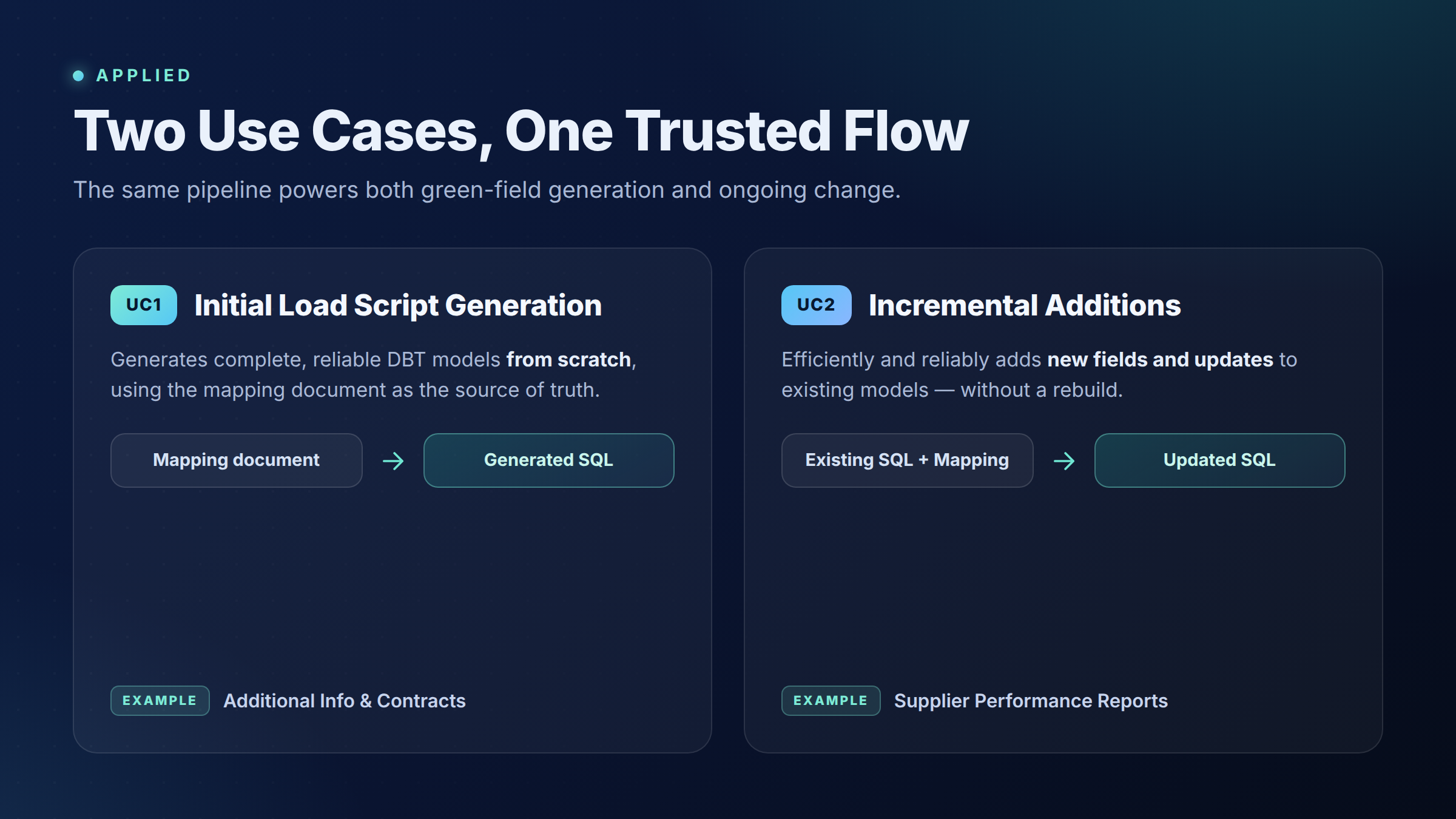
Here the AI builds complete dbt models from scratch, using the mapping document as the single source of truth. We used it to generate migration scripts for areas such as Additional Info and Contracts. The input is a mapping document; the output is generated SQL, reviewed before use.
Use case 2 — Incremental additions
The second use case handles change. We feed the existing SQL plus the mapping into the same flow, and the AI returns an updated model that adds new fields and updates — without a full rebuild. A representative example: adding Supplier Performance Reports to an existing model.
What makes the output reliable?
Three lessons stood out:
- Prompt engineering matters. Structured prompts significantly improve output quality and logic.
- Input quality is everything. AI performance directly reflects the precision of the mapping documents — vague inputs produce vague models.
- Human validation is non-negotiable. SME oversight remains essential for verifying generated SQL models and tuning them.
Security and governance, by design
Because this involves enterprise data, the guardrails came first, not last:
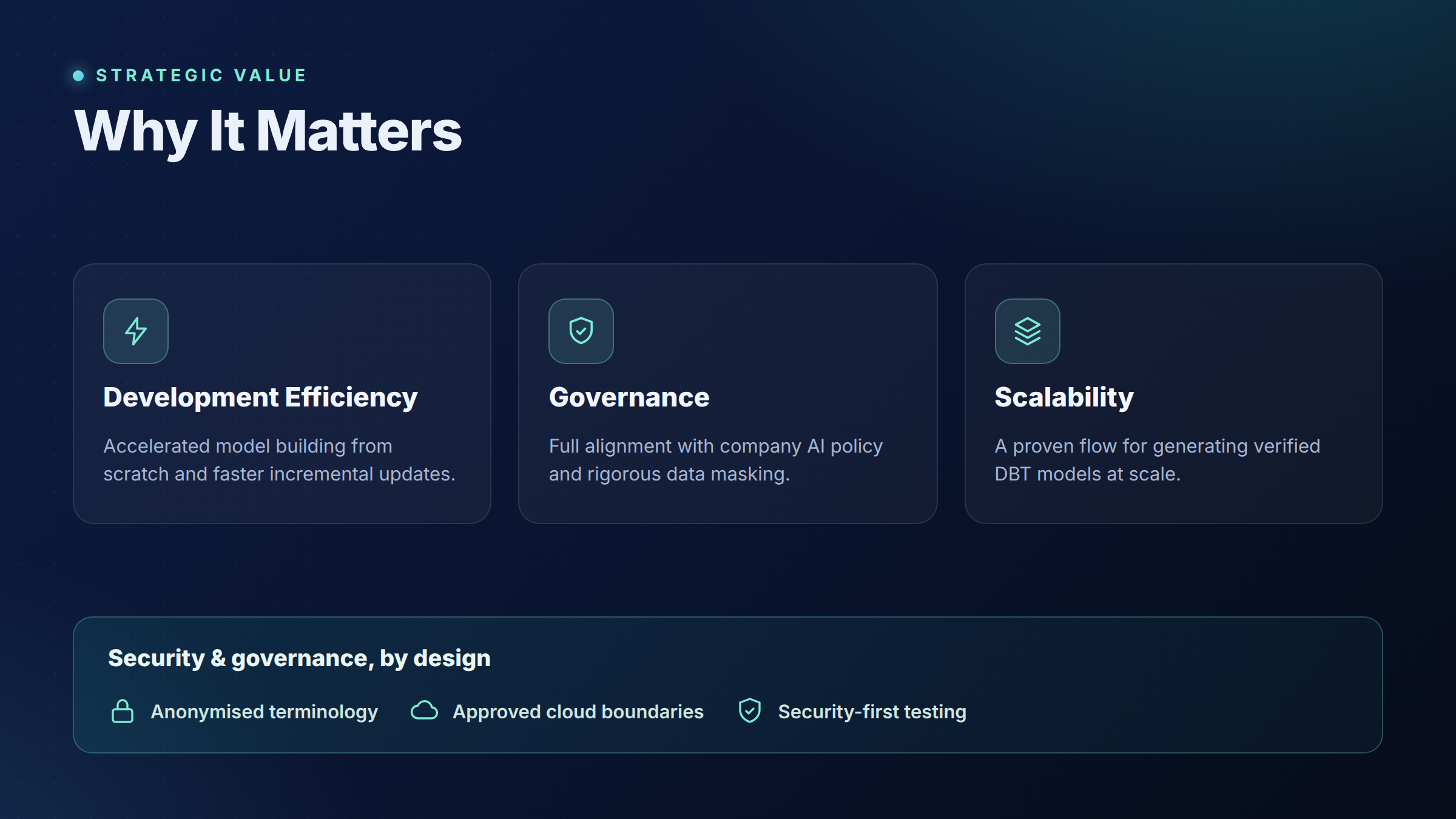
- Policy alignment — all work was conducted under the official company AI policy.
- Data privacy — every term was masked; no sensitive data was used.
- Security first — testing happened only within approved boundaries.
In practice that means anonymising all terminology to prevent data leakage, keeping data strictly within approved cloud environments, and applying a security-first approach to every code-generation task.
Why it matters
- Development efficiency — accelerated model building from scratch and faster incremental updates.
- Governance — full alignment with company AI policy and data masking.
- Scalability — a proven flow for generating verified dbt models at scale.
Frequently asked questions
What is AI-enabled data migration?
It's the use of generative AI to produce and update the transformation code — dbt models and SQL — that moves data from source to target, using existing mapping documents as input while keeping a subject-matter expert in the validation loop.
Can AI generate dbt models from scratch?
Yes. In our initial-load use case, the AI generates complete dbt models directly from a mapping document, which an SME then validates and tunes before use.
Still reading? Stop comparing — try CallSphere live.
CallSphere ships complete AI voice agents per industry — 14 tools for healthcare, 10 agents for real estate, 4 specialists for salons. See how it actually handles a call before you book a demo.
How does AI handle changes to existing models?
Our incremental use case feeds the existing SQL plus the mapping into the same flow, and the AI returns an updated model that adds new fields or changes — without rebuilding from scratch.
Is AI-generated migration SQL reliable?
Reliability comes from three things: structured prompting, precise mapping documents, and mandatory human SME review. The AI accelerates the draft; the SME verifies and tunes every model before it ships.
How is data privacy protected when using AI?
All terminology is masked so no sensitive data is exposed, work stays strictly within approved cloud environments, and every code-generation task follows a security-first approach under the official company AI policy.
Does this replace data engineers?
No. The flow is human-in-the-loop by design. SMEs remain essential for validating logic, tuning models, and ensuring the output meets requirements.
We're continuing to refine this flow. If you're running a migration program and weighing where AI fits — and where humans must stay in the loop — we'd value your questions and feedback. Learn more at Circini Limited.

Written by
Sagar Shankaran· Founder, CallSphere
LinkedInSagar Shankaran is the founder of CallSphere, where he builds production AI voice and chat agents deployed across healthcare, hospitality, real estate, and home services. He writes about agentic AI, LLM engineering, and shipping voice agents that handle real calls in production.
Try CallSphere AI Voice Agents
See how AI voice agents work for your industry. Live demo available -- no signup required.

