How European Union Teams Are Shipping Agentic AI in Real Estate in 2026
By Sagar Shankaran, Founder of CallSphere
Agentic AI in Real Estate in European Union: a 2026 field report on what production agentic AI teams are shipping, where the stack is converging, and the regulato...
Key takeaways
How European Union Teams Are Shipping Agentic AI in Real Estate in 2026
This 2026 field report looks at agentic ai in real estate as it plays out in the European Union — what teams are actually shipping, where the stack is converging, and where the real risks live.
The European Union is the world's most carefully regulated agentic AI market. Adoption is real but more measured than the US — enterprises invest substantially, with documentation and risk-assessment overhead built into every project. Hubs include Paris (Mistral, scale-up funds), Berlin (industrial + automotive AI), Amsterdam (B2B SaaS), Stockholm (open-source ecosystem), and Munich (deep-tech and robotics).
Agentic AI in Real Estate: The Production Picture
Real estate is where multimodal agents earn their keep. Buyers describe a vibe ("modern kitchen, near good schools"); the agent does semantic + photo analysis across the MLS. Tenants chat about leaks; the agent classifies severity, creates a maintenance ticket in AppFolio/Buildium/Yardi, and dispatches the right vendor. Brokerages get inbound buyer/seller capture 24/7 with CRM sync to Follow Up Boss or kvCORE.
The 2026 leaders ship 8-12 specialist agents — Property Search, Suburb Intelligence, Mortgage, Investment, Viewing Scheduler, Maintenance, Payments, Emergency. The pattern is hierarchical (Triage on top, specialists below) on OpenAI Agents SDK or LangGraph. Where it pays back: weekend and after-hours capture (most horizontal answering services lose these); multilingual buyer access; tenant emergency coverage. Where horizontal tools fall short: MLS depth, IDX integration, vertical CRM sync.
Why It Matters in European Union
EU enterprise adoption is significant and growing, with stronger emphasis on data residency and explainability than the US market. Pair that adoption velocity with the topic-specific patterns above and you get a real read on where agentic ai in real estate is converging in this region.
The EU AI Act sets the global high-water mark for AI regulation, with enforcement now active and a tiered risk classification that materially affects how agentic systems can be deployed. For agentic systems, regulation usually shapes the design choices around audit logging, data residency, and disclosure — none of which are afterthoughts in the European Union.
Hear it before you finish reading
Talk to a live CallSphere AI voice agent for real estate in your browser — 60 seconds, no signup.
Reference Architecture
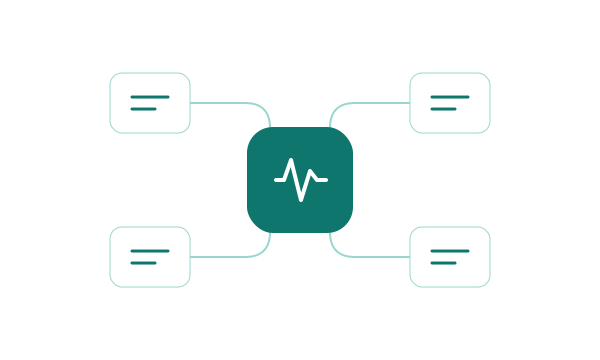
Here is the production-shaped reference architecture used by teams shipping this category in European Union:
flowchart TB
  VERT["Vertical workflow · the European Union"] --> DOMAIN["Domain agents
specialist tools"]
  DOMAIN --> SYS[("System of record
EHR · CRM · PMS · PSA")]
  DOMAIN --> KB[("Domain knowledge base
policies · SOPs · regs")]
  DOMAIN --> CHAN["Channels
voice · chat · email · ticket"]
  CHAN --> USR["End user"]
  USR --> CHAN
  SYS --> ANALYTICS["Vertical KPIs
conversion · resolution · CSAT"]
How CallSphere Plays
CallSphere Real Estate runs 10 specialist agents (Triage, Property Search w/ vision, Suburb Intelligence, Mortgage, Investment, Viewing, Maintenance, Payments, Emergency, Agent Matcher) on OpenAI Agents SDK. See it.
Frequently Asked Questions
Why do vertical agents beat horizontal ones in 2026?
Three reasons. (1) Domain-specific tools (EHR APIs, MLS feeds, PSA tickets) live behind verticalized integrations that horizontal builders cannot ship out of the box. (2) Domain language and intent — "verify insurance" means something specific in healthcare; a generic agent has to be trained or prompted into it. (3) Compliance — sector regs (HIPAA, FINRA, BIPA) ship as defaults in vertical products, not optional add-ons.
When is a horizontal builder good enough?
For internal tooling, prototypes, or simple FAQ bots — yes. For revenue-bearing customer flows in a regulated vertical, no. The cost of a missed appointment, a leaked PHI record, or a non-compliant disclosure is far higher than the savings on platform cost. Buy vertical, build glue code; do not build vertical from a generic builder.
How does CallSphere compare?
CallSphere ships complete vertical AI products — Healthcare (14 tools, post-call analytics), Real Estate (10 specialist agents with vision), Salon (4 agents into Vagaro/Boulevard/GlossGenius), Sales (batch outbound + 5 specialists), Property Management (7 agents + escalation ladder), and IT Helpdesk (10 agents + ChromaDB RAG). Not an API, not a builder — production AI, deployed in 24-72 hours.
Get In Touch
If you operate in the European Union and agentic ai in real estate is on your roadmap — book a scoping call. We will share the actual trade-offs we have seen across CallSphere's 6 production AI products.
- Live demo: callsphere.tech
- Book a call: /contact
- Read the blog: /blog
#AgenticAI #AIAgents #VerticalApplications #EU #CallSphere #2026 #AgenticAIinRealEstat
How European Union Teams Are Shipping Agentic AI in Real Estate in 2026 — operator perspective
When teams move beyond how European Union Teams Are Shipping Agentic AI in Real Estate in 2026, one question shows up first: where does the agent loop actually end? In practice, the boundary is rarely the model — it is the contract between the orchestrator and the tools it calls. That contract is what separates a demo from a production system. CallSphere learned this the expensive way while wiring 37 specialized agents to 90+ tools across 115+ database tables — every integration that didn't enforce schemas at the tool boundary eventually paged someone.
Still reading? Stop comparing — try CallSphere live.
See the real estate AI agent handle a real call — complete, industry-specific, and live in your browser. No signup.
Why this matters for AI voice + chat agents
Agentic AI in a real call center is a different beast than a single-LLM chatbot. Instead of one model answering one prompt, you orchestrate a small team: a router that decides intent, specialists that own a vertical (booking, intake, billing, escalation), and tools that read and write to the same Postgres your CRM trusts. Hand-offs are where most production bugs hide — when Agent A passes context to Agent B, anything that isn't explicit in the message gets lost, and the user feels it as the agent "forgetting." That's why the systems that hold up under load are the ones with typed tool schemas, deterministic state stored outside the conversation, and a hard ceiling on tool calls per session. The cost story is just as important: a multi-agent loop can quietly burn 10x the tokens of a single-LLM design if you let it think out loud at every step. The fix isn't a smarter model, it's smaller agents, shorter prompts, cached system messages, and evals that fail the build when p95 latency or per-session cost regresses. CallSphere runs this pattern across 6 verticals in production, and the rule has held every time: the agent you can debug in five minutes will out-survive the agent that's "smarter" on a benchmark.
FAQs
Q: How do you scale how European Union Teams Are Shipping Agentic AI in Real Estate in 2026 without blowing up token cost?
A: Scaling comes from constraint, not capability. The deployments that hold up keep each agent narrow, cap tool calls per turn, cache the system prompt, and pin a smaller model for routing while reserving the larger model for synthesis. CallSphere's stack — 37 agents · 90+ tools · 115+ DB tables · 6 verticals live — is sized that way on purpose.
Q: What stops how European Union Teams Are Shipping Agentic AI in Real Estate in 2026 from looping forever on edge cases?
A: Hard ceilings beat heuristics. A maximum step count, an idempotency key on every tool call, and a fallback to a deterministic script when confidence drops below a threshold are what keep the loop bounded. Evals that simulate noisy inputs catch the rest before they reach a real caller.
Q: Where does CallSphere use how European Union Teams Are Shipping Agentic AI in Real Estate in 2026 in production today?
A: It's already in production. Today CallSphere runs this pattern in After-Hours Escalation and Healthcare, alongside the other live verticals (Healthcare, Real Estate, Salon, Sales, After-Hours Escalation, IT Helpdesk). The same orchestrator code path serves voice and chat — the difference is the tool set the router exposes.
See it live
Want to see sales agents handle real traffic? Spin up a walkthrough at https://callsphere.ai/demo or grab 30 minutes on the calendar: https://callsphere.ai/book.

Written by
Sagar Shankaran· Founder, CallSphere
LinkedInSagar Shankaran is the founder of CallSphere, where he builds production AI voice and chat agents deployed across healthcare, hospitality, real estate, and home services. He writes about agentic AI, LLM engineering, and shipping voice agents that handle real calls in production.
Try CallSphere AI Voice Agents
See how AI voice agents work for your industry. Live demo available -- no signup required.