

Adding Knowledge to LLMs: Methods for Adapting Large Language Models
By Sagar Shankaran, Founder of CallSphere
Adding Knowledge to LLMs: Methods for Adapting Large Language Models
Key takeaways
Adding Knowledge to LLMs: Methods for Adapting Large Language Models
Large Language Models do not become powerful by accident. Their capabilities are the result of structured stages of development — from foundational training to domain specialization.
Understanding how knowledge is added to LLMs helps teams choose the right strategy for building production-ready AI systems.
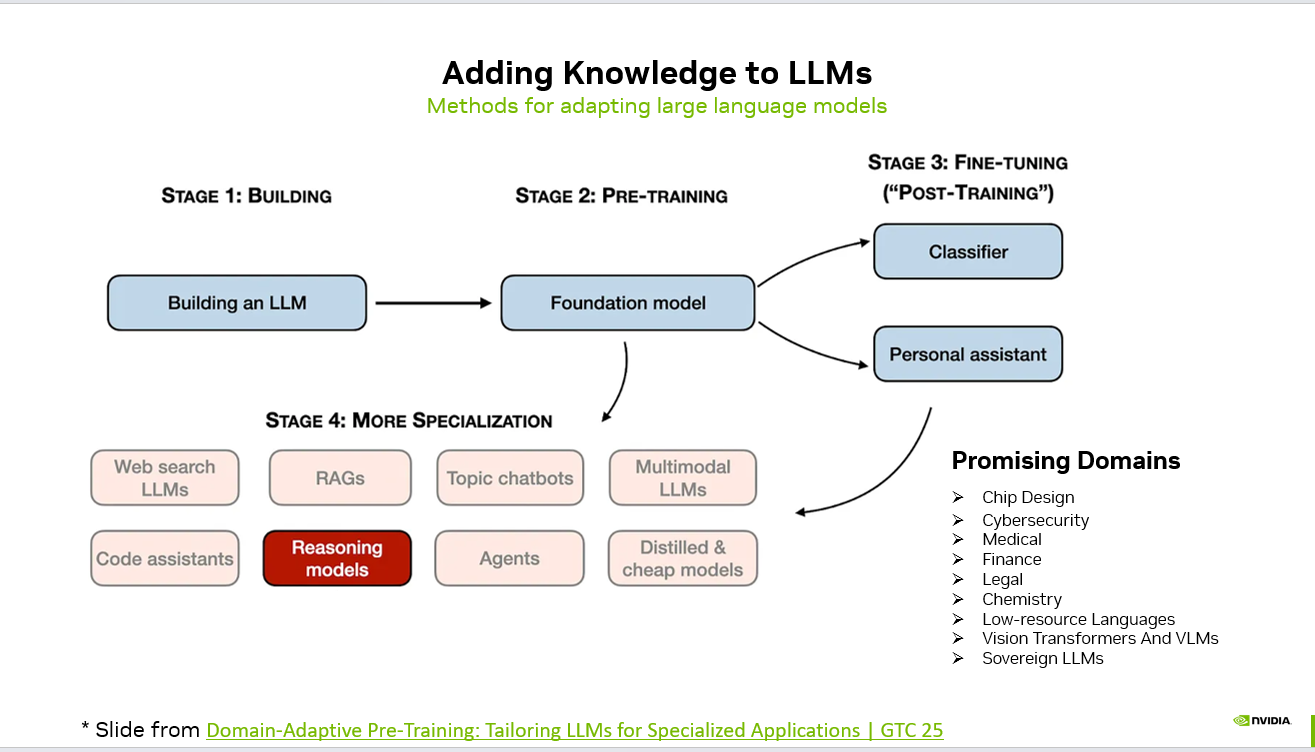
Stage 1: Building the Model
The journey begins with constructing the base architecture — defining parameters, training infrastructure, and scaling strategy.
This stage focuses on:
Model architecture design
Tokenization strategy
Training data pipelines
Distributed training systems
The output of this stage is the technical foundation required for large-scale learning.
Stage 2: Pre-Training (Foundation Model)
Pre-training transforms the architecture into a foundation model by exposing it to massive, diverse datasets.
flowchart LR
 DATA[("Curated dataset<br/>instruction or chat")]
 CLEAN["Clean and dedupe<br/>PII filter"]
 TOK["Tokenize and pack"]
 METHOD{"Method"}
 LORA["LoRA or QLoRA<br/>adapters only"]
 SFT["Full SFT<br/>all params"]
 DPO["DPO or RLHF<br/>preference learning"]
 EVAL["Held out eval<br/>plus regression suite"]
 DEPLOY[("Adapter or<br/>merged model")]
 DATA --> CLEAN --> TOK --> METHOD
 METHOD --> LORA --> EVAL
 METHOD --> SFT --> EVAL
 METHOD --> DPO --> EVAL
 EVAL --> DEPLOY
 style METHOD fill:#4f46e5,stroke:#4338ca,color:#fff
 style EVAL fill:#f59e0b,stroke:#d97706,color:#1f2937
 style DEPLOY fill:#059669,stroke:#047857,color:#fff
This phase enables the model to:
Learn language patterns
Acquire general world knowledge
Develop reasoning abilities
Understand syntax and semantics
Try Live Demo →Try Live →Hear it before you finish reading
Talk to a live CallSphere AI voice agent in your browser — 60 seconds, no signup.
The result is a general-purpose model capable of handling a wide variety of tasks.
Stage 3: Fine-Tuning (Post-Training)
Fine-tuning adapts the foundation model to specific applications.
Common outcomes include:
Classifiers for structured prediction tasks
Personal assistants optimized for dialogue
Instruction-following models
This stage often involves supervised fine-tuning, reinforcement learning from human feedback (RLHF), or alignment-focused optimization.
Stage 4: Advanced Specialization
Beyond fine-tuning, models can be further specialized using advanced techniques:
Retrieval-Augmented Generation (RAG)
Web-search integrated LLMs
Topic-specific chatbots
Code assistants
Reasoning-optimized models
AI agents capable of multi-step workflows
Distilled and cost-efficient models
Multimodal LLMs (text + vision)
This is where models evolve from general intelligence to domain expertise.
Promising Application Domains
As specialization improves, LLMs are increasingly applied in high-impact domains:
Chip design
Cybersecurity
Medical and healthcare
Still reading? Stop comparing — try CallSphere live.
CallSphere ships complete AI voice agents per industry — 14 tools for healthcare, 10 agents for real estate, 4 specialists for salons. See how it actually handles a call before you book a demo.
Finance
Legal systems
Chemistry and scientific research
Low-resource language support
Vision-language systems (VLMs)
Sovereign AI initiatives
Why This Matters
Adding knowledge to LLMs is not a single step — it is a layered process combining architecture, data, alignment, and specialization.
For AI builders, the key questions are:
Do you need broader intelligence or deeper domain expertise?
Should you fine-tune, use RAG, or build agents?
Is cost-efficiency more important than scale?
Understanding these stages allows teams to design AI systems that are not only powerful — but purpose-built.
Source: NVIDIA
#AI #MachineLearning #LLM #GenerativeAI #AIEvaluation #MLOps #AIEngineering #RAG #AIResearch #DomainAdaptation
Adding Knowledge to LLMs: Methods for Adapting Large Language Models — operator perspective
Behind Adding Knowledge to LLMs: Methods for Adapting Large Language Models sits a smaller, more useful question: which production constraint just got cheaper to solve — first-token latency, language coverage, structured outputs, or tool-call reliability? On the CallSphere side, the practical filter is simple: would this make a 90-second appointment-booking call faster, cheaper, or more reliable? If the answer is "maybe in a benchmark," it doesn't ship to production.
Base model vs. production LLM stack — the gap that costs you uptime
A base model is a checkpoint. A production LLM stack is a whole different artifact: eval gates that fail the build on regression, prompt caching that cuts repeated-system-prompt cost by 40-70%, structured outputs that prevent JSON drift on tool calls, fallback chains that route to a smaller-model retry when the primary times out, and request-side guardrails that cap tool calls per session before the loop spirals. CallSphere runs LLMs in tandem on purpose: gpt-4o-realtime for the live call (streaming audio in and out, tool calls inline) and gpt-4o-mini for post-call analytics (sentiment scoring, lead qualification, summary generation, and the lower-stakes async work that doesn't need realtime). That split is not a cost optimization — it's a reliability decision. Realtime is optimized for low-latency turn-taking; mini is optimized for cheap, deterministic batch scoring. Mixing them lets each do what it's good at without one regressing the other. The teams that struggle with LLMs in production almost always made the same mistake: they treated "the model" as a single dependency, instead of as a small portfolio of models, each pinned to a job, each behind its own eval suite, each with a documented fallback.
FAQs
Q: Why isn't adding Knowledge to LLMs an automatic upgrade for a live call agent?
A: Most of the time it doesn't, and that's the right starting assumption. The relevant test is whether it improves at least one of: p95 first-token latency, tool-call argument accuracy on noisy inputs, multi-turn handoff stability, or per-session cost. CallSphere ships in 57+ languages, is HIPAA aligned, and runs voice, chat, SMS, and WhatsApp from the same agent stack.
Q: How do you sanity-check adding Knowledge to LLMs before pinning the model version?
A: The eval gate is unsentimental — a regression suite that simulates real call traffic (noisy ASR, partial inputs, tool-call timeouts) measures four numbers, and a candidate has to win on three of four without losing badly on the fourth. Anything else is treated as a blog post, not a stack change.
Q: Where does adding Knowledge to LLMs fit in CallSphere's 37-agent setup?
A: In a CallSphere deployment, new model and API capabilities land first in the post-call analytics pipeline (lower stakes, async, easy to roll back) and only later in the live realtime path. Today the verticals most likely to absorb new capability first are Salon and Real Estate, which already run the largest share of production traffic.
See it live
Want to see after-hours escalation agents handle real traffic? Walk through https://escalation.callsphere.tech or grab 30 minutes with the founder: https://callsphere.ai/book.

Written by
Sagar Shankaran· Founder, CallSphere
LinkedInSagar Shankaran is the founder of CallSphere, where he builds production AI voice and chat agents deployed across healthcare, hospitality, real estate, and home services. He writes about agentic AI, LLM engineering, and shipping voice agents that handle real calls in production.
Try CallSphere AI Voice Agents
See how AI voice agents work for your industry. Live demo available -- no signup required.


